> ## Documentation Index
> Fetch the complete documentation index at: https://instro.nominal.io/llms.txt
> Use this file to discover all available pages before exploring further.
# Arbitrary Waveform Generator (AWG)
> Using InstroAWG for SCPI-based arbitrary waveform generators
`InstroAWG` provides a unified interface for arbitrary waveform generators. This class is initialized with a vendor-specific driver (`RigolDG1022Z`, `Keysight33521B`, …), and provides the vendor-agnostic API (`set_waveform`, `set_amplitude`, `set_offset`, `set_modulation`, `set_sweep`, …).
## Creating an InstroAWG
```python theme={null}
from instro.awg.drivers import RigolDG1022Z
from instro.awg import InstroAWG
awg = InstroAWG(
name="myAWG",
driver=RigolDG1022Z(visa_resource="USB0::0x1AB1::0x0642::DG1ZA000000000::INSTR"),
num_channels=2,
)
```
## Supported Vendors
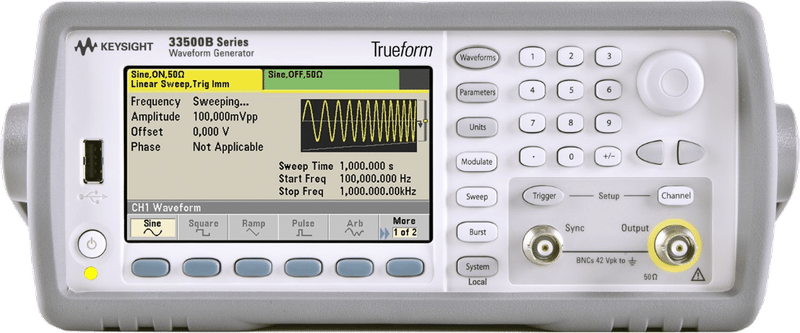
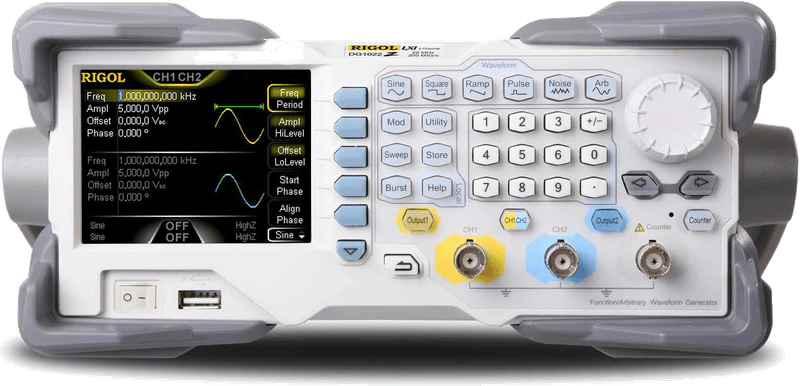 If your vendor or model is not listed, see [Custom Driver Development](/library/custom-instruments#arbitrary-waveform-generator-awg), or open a [Driver Request](https://github.com/nominal-io/instro/issues) issue on GitHub.
## Example
More examples found in [Examples](/examples/awg/index)
## Details
The following presents details about the `InstroAWG`. Specific driver details can be found on [their pages](#supported-vendors).
### Driver Composition
An `InstroAWG` is built from a concrete driver:
```python theme={null}
InstroAWG("name", driver=RigolDG1022Z(visa_resource="USB0::..."), num_channels=2)
```
* The **`RigolDG1022Z`** owns the connection setup and vendor-specific command mapping.
* **`InstroAWG`** owns the category-level workflow: waveform programming, publishers, the background daemon.
### Lifecycle
The typical InstroAWG workflow:
1. **Construct**: instantiate the vendor driver and pass it to `InstroAWG`, along with the channel count.
2. **`open()`**: establishes the connection to the instrument.
3. **Configure and generate**: define a waveform on a channel, set its amplitude and offset, and enable the output, etc.
4. **`start()`**: begins a periodic background daemon that polls output state. (Optional)
5. **`stop()`**: ends the background daemon (if started).
6. **`close()`**: disconnects from hardware.
### Waveform Definitions
InstroAWG supports programming a channel with the following waveforms: `Sine`, `Square`, `Sawtooth`, `Triangle`, `Pulse`, `Arbitrary`, or `StaticValue`. These are all frozen dataclasses in `instro.awg`.
`Arbitrary` requires a sample rate field (`sample_rate_sas`, in samples per second) to specify the number of samples that the internal DAC outputs per second.
**Driver support varies**
Certain features are only available on particular waveforms. Drivers own their implementation of features in InstroAWG. Consult your specific driver for exact support.
`RigolDG1022Z` uses a bulk transfer for arbitrary waveforms over TCPIP when the complete command is smaller than 32 KiB. USB connections and larger TCPIP payloads use per-point transfers because bulk writes can hang the instrument firmware in those cases.
### Init from a Config File
`InstroAWG` can also be constructed directly from a JSON config file. See below for an example Rigol DG1022Z JSON configuration.
```json theme={null}
{
"version": 1,
"instrument": "InstroAWG",
"device": {
"name": "bench_awg",
"description": "Bench waveform generator",
"manufacturer": "Rigol",
"model": "DG1022Z"
},
"driver": {
"connection_type": "visa",
"name": "RigolDG1022Z",
"num_channels": 2,
"visa": {
"visa_resource": "USB0::0x1AB1::0x0642::DG1ZA000000000::INSTR"
}
},
"channels": {
"1": {
"waveform": { "shape": "sine", "frequency_hz": 1000.0, "phase_deg": 0.0 },
"amplitude": { "value": 2.0, "unit": "VPP" },
"offset": 0.0
}
},
"timing": {
"poll_interval": 1.0
},
"publishers": [
{ "type": "NominalCorePublisher", "dataset_rid": "" }
]
}
```
```python theme={null}
from instro.awg import InstroAWG
awg = InstroAWG(config="bench_awg.json")
```
See [Config Files](/library/config-files) for the full field reference.
## Custom Driver Development
For more information on writing a custom driver, see [Custom Driver Development](/library/custom-instruments#arbitrary-waveform-generator-awg).
If your vendor or model is not listed, see [Custom Driver Development](/library/custom-instruments#arbitrary-waveform-generator-awg), or open a [Driver Request](https://github.com/nominal-io/instro/issues) issue on GitHub.
## Example
More examples found in [Examples](/examples/awg/index)
## Details
The following presents details about the `InstroAWG`. Specific driver details can be found on [their pages](#supported-vendors).
### Driver Composition
An `InstroAWG` is built from a concrete driver:
```python theme={null}
InstroAWG("name", driver=RigolDG1022Z(visa_resource="USB0::..."), num_channels=2)
```
* The **`RigolDG1022Z`** owns the connection setup and vendor-specific command mapping.
* **`InstroAWG`** owns the category-level workflow: waveform programming, publishers, the background daemon.
### Lifecycle
The typical InstroAWG workflow:
1. **Construct**: instantiate the vendor driver and pass it to `InstroAWG`, along with the channel count.
2. **`open()`**: establishes the connection to the instrument.
3. **Configure and generate**: define a waveform on a channel, set its amplitude and offset, and enable the output, etc.
4. **`start()`**: begins a periodic background daemon that polls output state. (Optional)
5. **`stop()`**: ends the background daemon (if started).
6. **`close()`**: disconnects from hardware.
### Waveform Definitions
InstroAWG supports programming a channel with the following waveforms: `Sine`, `Square`, `Sawtooth`, `Triangle`, `Pulse`, `Arbitrary`, or `StaticValue`. These are all frozen dataclasses in `instro.awg`.
`Arbitrary` requires a sample rate field (`sample_rate_sas`, in samples per second) to specify the number of samples that the internal DAC outputs per second.
**Driver support varies**
Certain features are only available on particular waveforms. Drivers own their implementation of features in InstroAWG. Consult your specific driver for exact support.
`RigolDG1022Z` uses a bulk transfer for arbitrary waveforms over TCPIP when the complete command is smaller than 32 KiB. USB connections and larger TCPIP payloads use per-point transfers because bulk writes can hang the instrument firmware in those cases.
### Init from a Config File
`InstroAWG` can also be constructed directly from a JSON config file. See below for an example Rigol DG1022Z JSON configuration.
```json theme={null}
{
"version": 1,
"instrument": "InstroAWG",
"device": {
"name": "bench_awg",
"description": "Bench waveform generator",
"manufacturer": "Rigol",
"model": "DG1022Z"
},
"driver": {
"connection_type": "visa",
"name": "RigolDG1022Z",
"num_channels": 2,
"visa": {
"visa_resource": "USB0::0x1AB1::0x0642::DG1ZA000000000::INSTR"
}
},
"channels": {
"1": {
"waveform": { "shape": "sine", "frequency_hz": 1000.0, "phase_deg": 0.0 },
"amplitude": { "value": 2.0, "unit": "VPP" },
"offset": 0.0
}
},
"timing": {
"poll_interval": 1.0
},
"publishers": [
{ "type": "NominalCorePublisher", "dataset_rid": "" }
]
}
```
```python theme={null}
from instro.awg import InstroAWG
awg = InstroAWG(config="bench_awg.json")
```
See [Config Files](/library/config-files) for the full field reference.
## Custom Driver Development
For more information on writing a custom driver, see [Custom Driver Development](/library/custom-instruments#arbitrary-waveform-generator-awg).